WHICH
Low-temperature geothermal resources (<100°C) are generally used in direct thermal applications. Beyond the classic balneology, their heat is used for heating and cooling environments through geothermal probes and geostructures, heating entire neighborhoods and cities, fish farming, floriculture, milk pasteurization and cheese production, brewing, food drying, and paper production. In contrast, the heat from medium and high-temperature resources (>100°C) is generally used indirectly for geothermal electricity production.
The choice of application is closely linked to the temperature of the geothermal fluid (enthalpy) and the depth at which the fluid is found.
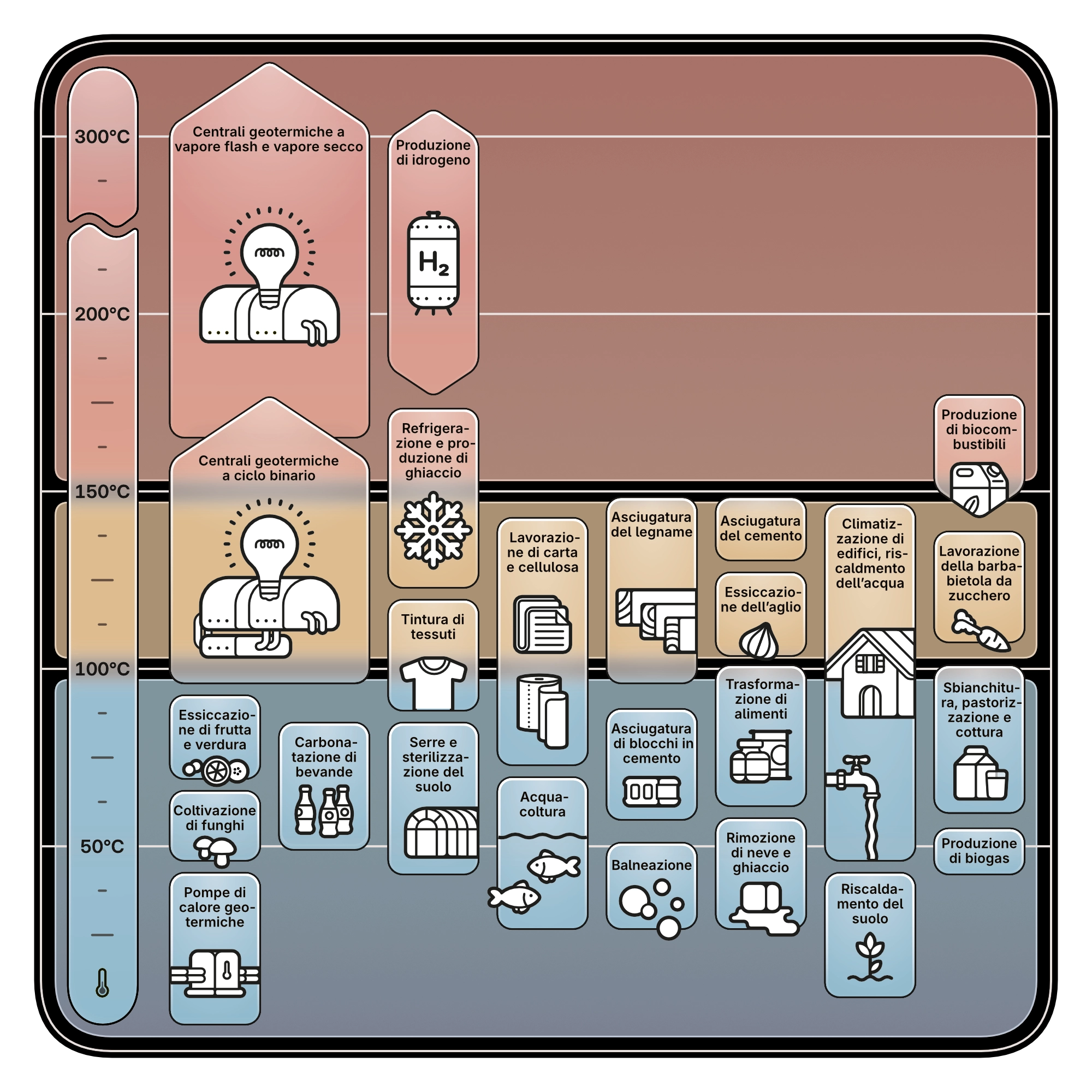
Illustration on the uses of geothermal resources based on temperature
Typically, the resources used for direct thermal applications are found at depths of tens to hundreds of meters, while those useful for electricity production are located at depths of about a kilometer.
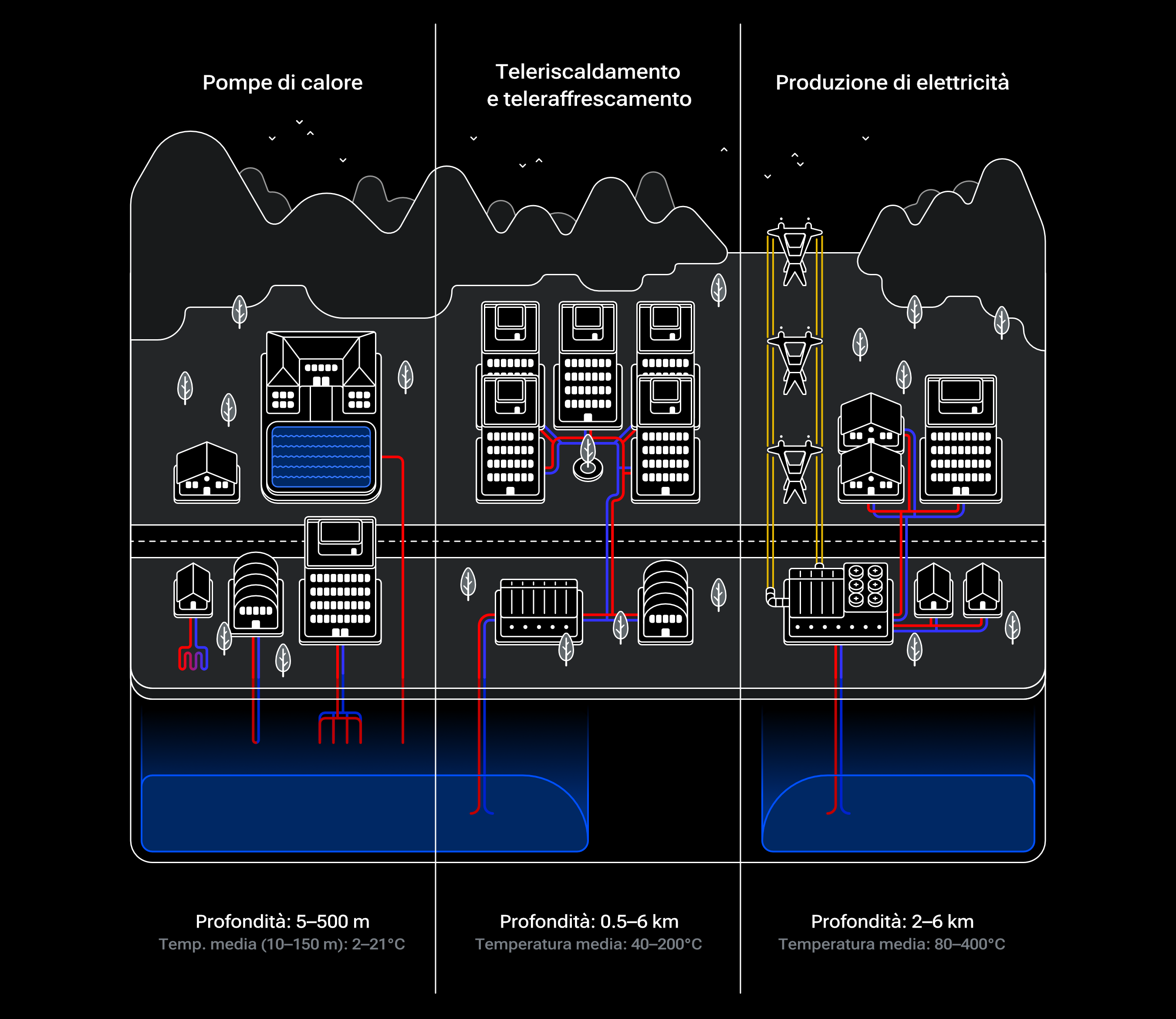
How is it Possible to Produce Electricity from Earth's Heat?
The answer lies in the steam, which, through extraction wells, rises to the surface from a geothermal reservoir (rocks rich in fluids) located thousands of meters deep, then reaches the turbines and generates mechanical energy, which thanks to an alternator is transformed into alternating electrical energy and then transmitted to the transformer to allow distribution in the network. The water produced by the condensation of the steam is then re-injected into the subsoil through reinjection wells, following specific protocols. Generally, these geothermal reservoirs have temperatures above 235°C and are extremely rich in steam (steam-dominated systems).
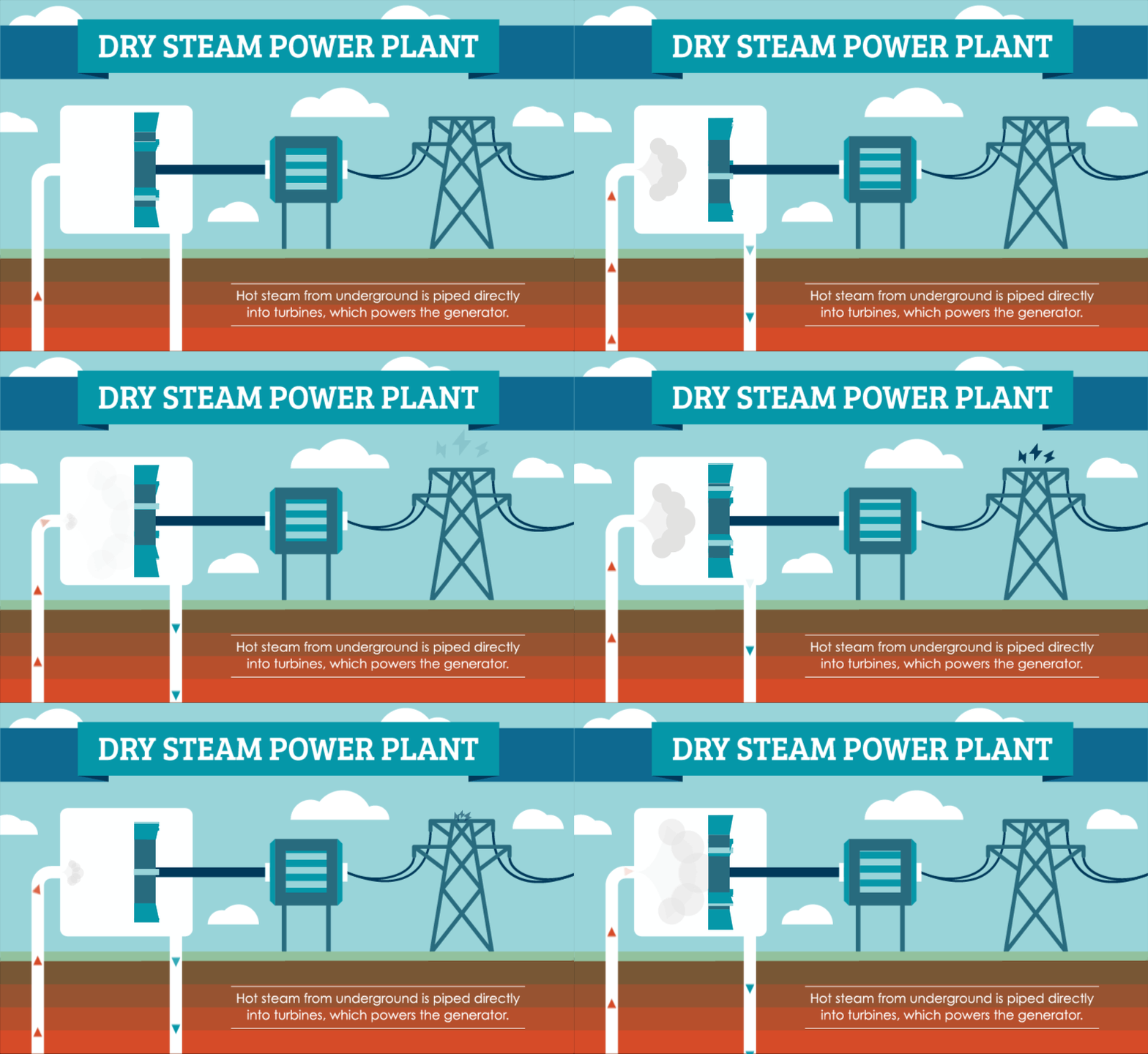
Simplified diagram of a geothermal plant (dry steam type) that produces electricity using steam (https://www.saveonenergy.com)
Most geothermal systems from which electricity is produced are “liquid-dominated,” have temperatures greater than 150-170°C, and the fluid in the reservoir is almost entirely hot water and only a small part steam. In this case, the water that rises from the extraction wells, due to depressurization, turns into steam (flash process). The steam then reaches the turbines and follows the alternator-transformer process described earlier.
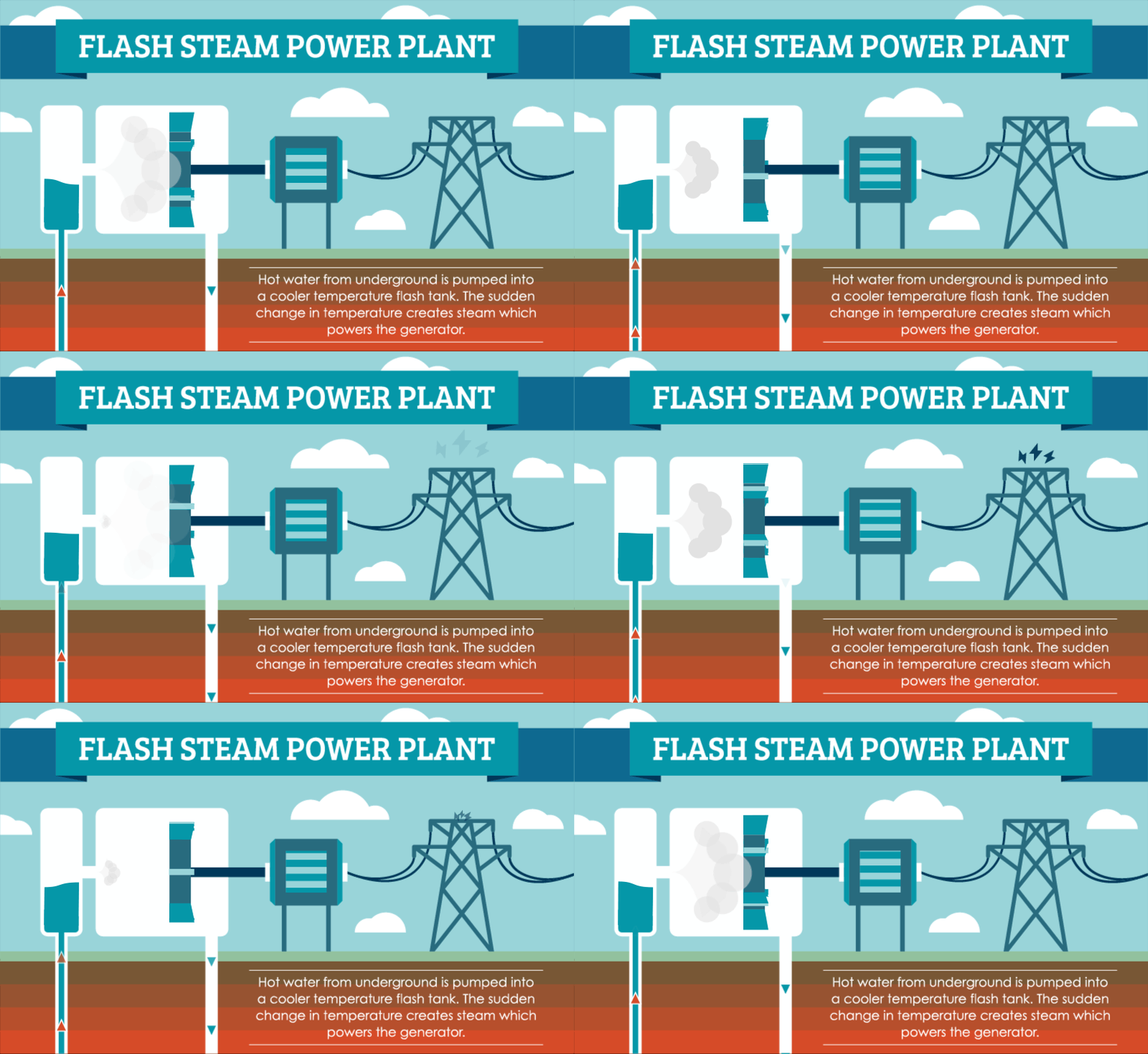
Simplified diagram of a geothermal plant (flash steam type) that produces electricity using steam formed following the rise of very hot water (https://www.saveonenergy.com/green-energy/geothermal-energy/)
In geothermal reservoirs characterized by water at moderate temperatures (between 120 and 180 °C), the geothermal fluid is used to vaporize, through a heat exchanger, a second fluid (usually isobutane or isopentane), with a lower boiling point than water. The secondary fluid expands in the turbine and is condensed and returned to the exchanger in a closed circuit, without exchanges with the outside. This type of technology is called a binary cycle.
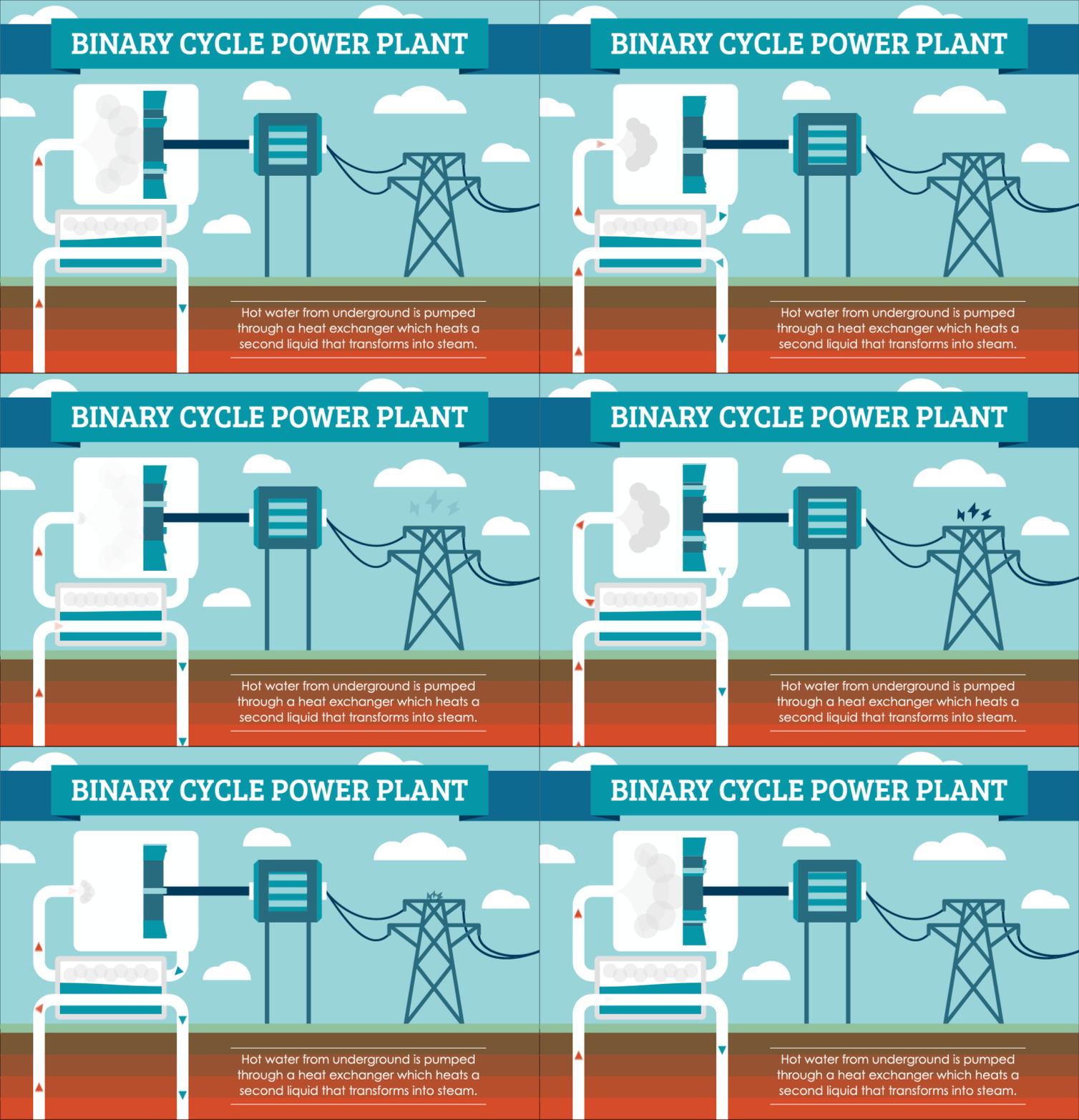
Simplified diagram of a geothermal plant (binary cycle type) where the steam used in the electricity production process comes from the vaporization of a secondary fluid heated by the geothermal fluid (Source: https://www.saveonenergy.com/green-energy/geothermal-energy/)